
You may also like
Because of the way we prioritise the left hemisphere’s take on the world, we have ceased to appreciate the meaning of continuity […]
In 1941 the mathematician Luigi Fantappiè introduced a new type of causality into the explanation of life and evolution. The equations which combine quantum mechanics and special relativity show that, in addition to causality, retrocausality is also an ingredient of our universe. Whereas causality is governed by the law of entropy (diverging tendency), retrocausality is governed by a symmetrical law which leads to the increase of differentiation, complexity and structures. Combining the two Greek words syn=converging and tropos=tendency Fantappiè coined the word syntropy in order to describe the retrocausal action of attractors, the converging tendency of evolution towards a final unifying cause which he named love.
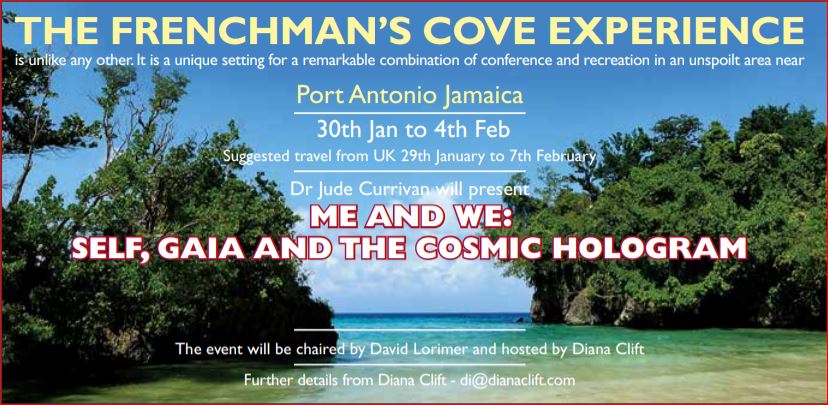
Science is now transcending the materialist philosophy, and pointing toward a new sense of a living world. The cosmos is no longer like a machine running down; it is more like a developing organism with an inherent memory, and so is our planet, Gaia. The old idea of determinism has given way to indeterminism, chaos and complexity. The laws of nature may be more like habits. Minds may extend far beyond brains. Memories may not be stored as traces in our brains, and may not be wiped out at death. Mental causation may work from the future towards the past, while energetic causation works from the past towards the future. New experimental research points to the reality of our mental connections to the world around us. These new paradigm shifts in the sciences shed a new light on spiritual practices like pilgrimage, ritual, prayer and the survival of bodily death. In this workshop we will explore some of these many implications.
Why is psychiatry such big business? Why are so many psychiatric drugs prescribed, and why, without solid scientific justification, has the number of mental disorders risen from 106 in 1952, to around 370 today? In this talk, Dr James Davies takes us behind the scenes of how the psychiatrist’s bible, the DSM, was actually written – did science drive the construction of new mental disorder categories like ADHD, major depression and Aspergers? ‘ or were less-scientific and unexpected processes at play? His exclusive interviews with the creators of the DSM reveal the answer.